Rabu, 29 Mei 2019

Stocks making the biggest moves premarket: Dick's Sporting Goods, Boeing, Uber, Workday & more - CNBC

Check out the companies making headlines before the bell:

Dick's Sporting Goods — The sporting goods retailer beat estimates by 4 cents a share, with adjusted quarterly profit of 62 cents per share. Revenue beat forecasts as well. Comparable-store sales were flat, better than the forecast of a 1.3% decline by analysts polled by Refinitiv. Dick's also raised its full-year outlook.

Abercrombie & Fitch — The apparel seller lost 29 cents per share for its latest quarter, smaller than the 43 cents a share loss that analysts were anticipating. Revenue topped estimates as well, although a comparable-store sales increase of 1% fell slightly short of the 1.3% consensus estimate.

Capri Holdings — The company formerly known as Michael Kors reported adjusted quarterly profit of 63 cents per share, beating estimates by 2 cents a share. The luxury goods retailer's revenue also came in above forecasts, helped by strength at its Versace and Jimmy Choo brands. Capri gave a weaker-than-expected current-quarter forecast, however, as it spends more on marketing and new store openings.

Canada Goose — The outerwear maker reported adjusted quarterly profit of 9 cents per share (Canadian), beating the consensus estimate of 5 cents a share. Revenue was below estimates, however, and Canada Goose also gave a weaker-than-expected outlook.

Workday — Workday earned an adjusted 43 cents per share for its latest quarter, beating estimates by 2 cents a share. The maker of human resources software's revenue come in above forecasts, as it signed up more business subscribers.

Boeing — The 737 Max jet may not return to service until August, according to the head of the International Air Transport Association. Alexandre de Juniac told reports that the group plans to organize a summit of regulators and airlines in five to seven weeks to discuss what may be needed to allow the 737 Max to fly again.

T-Mobile, Sprint — The two wireless carriers could sell the prepaid wireless brand Boost Mobile for up to $3 billion, according to interested bidders who spoke to Reuters. The sale of Boost is among the concessions offered to win Federal Communications Commission approval of the deal. Boost Mobile founder Peter Adderton, who is interested in buying back boost, will be a guest on CNBC's Squawk Alley today at 11 a.m. ET.

Bed Bath & Beyond — The housewares retailer has added four new independent directors to its board, in a settlement with an investor group consisting of Legion Partners Asset Management, Macellum Advisors, and Ancora Advisors. The group said it was pleased with the move.

Morningstar — The financial information company announced the acquisition of credit ratings agency DBRS for $669 million.

Devon Energy — The energy producer announced the sale of its Canada business to Canadian Natural Resources for $2.8 billion. Devon plans to use the proceeds to reduce debt.

Uber Technologies — Uber CEO Dara Khosrowshahi told the German newspaper Handelsblatt that the ride-hailing company will not achieve profitability in the next year or two, but that it will come.

Toyota — The automaker is considering an investment of about $550 million in China-based ride-hailing company Didi Chuxing, according to Japan's Nikkei business daily.

Heico — Heico reported quarterly profit of 60 cents per share, 11 cents a share above estimates. Revenue came in well above forecasts and the aircraft parts maker raised its financial forecast for the year.

General Mills — The food producer's stock was downgraded to "sell" from "neutral" at Goldman Sachs, which said that its December prediction that short term strength might be followed mounting deceleration is now playing out.

Amazon, Facebook, Trade Desk, Twitter — In a report on internet advertising, Pivotal Research said that it would pay to be selective in this area, and issued "buy" ratings on these four stocks because of their leadership positions, among other factors. It rates Alphabet, Snap, and Pinterest at "hold."

Let's block ads! (Why?)


https://www.cnbc.com/2019/05/29/stocks-making-the-biggest-moves-premarket-dicks-sporting-goods-boeing-uber-workday-more.html

2019-05-29 11:50:28Z
52780304783643

Opinion | Trump Hands China an Easy Win in the Trade War - The New York Times

When President Trump tweeted on May 5 that the China trade deal was off, the historical echoes in Beijing were loud and clear. Almost exactly 100 years earlier, China’s “May Fourth Movement” of 1919 was a direct response to the actions of President Woodrow Wilson at the end of World War I. Wilson had promised China, an American ally, that German colonies in Shandong would be returned to Chinese sovereignty, but instead handed them to Japan. China exploded with anti-American, nationalist sentiment. One of the eventual consequences was the establishment of the Chinese Communist Party, which for the last 70 years has ruled the country.

Thus, Mr. Trump has handed Xi Jinping a remarkably effective nationalist card to play at a time when he has been under pressure at home because of a slowing economy. The Chinese media is now full of accounts of the country’s economic resilience and appeals to patriotism, even invoking the spirit of the Korean War, when, according to the official narrative, China was able to stare down the vastly superior American military.

And just in case people didn’t get the point, Mr. Xi recently visited Jiangxi, the starting point of the Long March in 1934, in which the Communist Party endured many hardships but ultimately emerged victorious.

I can almost hear members of the Trump administration groaning. Why on earth would they need to take into consideration events in China’s ancient past?

The answer depends on what Mr. Trump’s primary objective is. If it’s to sound tough to American voters, he may well have a winning formula. But if it’s to bring about a substantive change in China’s negotiating posture toward a bilateral trade agreement, one that might usher in changes in China’s trade policy, addressing questions of forced technology transfers, intellectual property theft, industrial subsidies, currency manipulation and a phalanx of other non-tariff barriers, I’m not so sure.

Days after the president’s tweets, China listed three “red lines,” positions the United States had taken in the trade talks that were unacceptable: First, that it would keep tariffs in place for a period after the proposed trade agreement was signed. Second, that it could impose punitive tariffs if it judged China to be in violation of the agreement, and that China would be forbidden from retaliating with its own tariffs. Third, the ever-inflating expectations of the terms under which Beijing would buy American goods under a proposed bilateral purchasing agreement.

These “red lines” were new. Before that, China’s negotiating team had a fully flexible remit from the leadership. But not anymore. Now that these three lines are in the public domain, there is no way Chinese leaders can yield on them. The leaks of large parts of the negotiating text to the American news media has added a new level of toxicity, making it virtually impossible to return to the existing text as a basis of negotiations. Together with recent moves against the Chinese telecom company Huawei presumably intended to pressure Beijing further, the possibility of negotiating a revised agreement that is more accommodating to American interests is now very slim.

Instead, what I have seen in Beijing over the last few weeks is a country moving in exactly the opposite direction.

Economic analysts, meanwhile, have been calculating the impact of a full-blown trade war, estimating a loss of about 1.2 percentage points to Chinese G.D.P. growth. This figure is now portrayed in the Chinese media as entirely manageable given China’s capacity to use fiscal and monetary policy stimulus to support domestic demand and keep growth above 6 percent.

Even if a trade deal with the United States is still possible, some in the Chinese leadership are now starting to ask, why bother? They argue that in technology, investment, foreign policy, national security and human rights, the Trump administration has made it clear that it has embarked on a more adversarial position toward China. So why should Beijing expend any more political capital on a trade deal? Perhaps it’s better, in China’s view, to cut its losses now and get ready for the next Cold War.

If that’s what the Trump administration wants, its strategy has been a great success. If not, and the president really wants a trade deal, with reasonable decreases in the bilateral trade deficit, and some substantive changes in Chinese economic behavior, the American negotiating strategy requires some serious recalibration.

Of course, China’s public position is that negotiations can continue. Even within the framework of the new “red lines,” there may still be room for a deal. China might agree to purchase more American goods, with America yielding on the retention of tariffs, and the unilateral right to impose tariffs later. However, the degree of difficulty in getting to an agreement has now increased substantially.

The bottom line is that nationalism is not just a factor in Trump’s America. It’s now a big factor in Xi Jinping’s China as well, reinforced through the prism of Chinese history. In most of its dealings with America over the last 100 years, China has seen itself as weak. Today, in Beijing’s view, China is weak no longer.

Kevin Rudd, a former prime minister of Australia, is president of the Asia Society Policy Institute in New York.

The Times is committed to publishing a diversity of letters to the editor. We’d like to hear what you think about this or any of our articles. Here are some tips. And here’s our email: letters@nytimes.com.

Follow The New York Times Opinion section on Facebook, Twitter (@NYTopinion) and Instagram.

Let's block ads! (Why?)


https://www.nytimes.com/2019/05/29/opinion/trump-china-trade-war.html

2019-05-29 10:08:23Z
52780305137219

Opinion | Trump Hands China an Easy Win in the Trade War - The New York Times

When President Trump tweeted on May 5 that the China trade deal was off, the historical echoes in Beijing were loud and clear. Almost exactly 100 years earlier, China’s “May Fourth Movement” of 1919 was a direct response to the actions of President Woodrow Wilson at the end of World War I. Wilson had promised China, an American ally, that German colonies in Shandong would be returned to Chinese sovereignty, but instead handed them to Japan. China exploded with anti-American, nationalist sentiment. One of the eventual consequences was the establishment of the Chinese Communist Party, which for the last 70 years has ruled the country.

Thus, Mr. Trump has handed Xi Jinping a remarkably effective nationalist card to play at a time when he has been under pressure at home because of a slowing economy. The Chinese media is now full of accounts of the country’s economic resilience and appeals to patriotism, even invoking the spirit of the Korean War, when, according to the official narrative, China was able to stare down the vastly superior American military.

And just in case people didn’t get the point, Mr. Xi recently visited Jiangxi, the starting point of the Long March in 1934, in which the Communist Party endured many hardships but ultimately emerged victorious.

I can almost hear members of the Trump administration groaning. Why on earth would they need to take into consideration events in China’s ancient past?

The answer depends on what Mr. Trump’s primary objective is. If it’s to sound tough to American voters, he may well have a winning formula. But if it’s to bring about a substantive change in China’s negotiating posture toward a bilateral trade agreement, one that might usher in changes in China’s trade policy, addressing questions of forced technology transfers, intellectual property theft, industrial subsidies, currency manipulation and a phalanx of other non-tariff barriers, I’m not so sure.

Days after the president’s tweets, China listed three “red lines,” positions the United States had taken in the trade talks that were unacceptable: First, that it would keep tariffs in place for a period after the proposed trade agreement was signed. Second, that it could impose punitive tariffs if it judged China to be in violation of the agreement, and that China would be forbidden from retaliating with its own tariffs. Third, the ever-inflating expectations of the terms under which Beijing would buy American goods under a proposed bilateral purchasing agreement.

These “red lines” were new. Before that, China’s negotiating team had a fully flexible remit from the leadership. But not anymore. Now that these three lines are in the public domain, there is no way Chinese leaders can yield on them. The leaks of large parts of the negotiating text to the American news media has added a new level of toxicity, making it virtually impossible to return to the existing text as a basis of negotiations. Together with recent moves against the Chinese telecom company Huawei presumably intended to pressure Beijing further, the possibility of negotiating a revised agreement that is more accommodating to American interests is now very slim.

Instead, what I have seen in Beijing over the last few weeks is a country moving in exactly the opposite direction.

Economic analysts, meanwhile, have been calculating the impact of a full-blown trade war, estimating a loss of about 1.2 percentage points to Chinese G.D.P. growth. This figure is now portrayed in the Chinese media as entirely manageable given China’s capacity to use fiscal and monetary policy stimulus to support domestic demand and keep growth above 6 percent.

Even if a trade deal with the United States is still possible, some in the Chinese leadership are now starting to ask, why bother? They argue that in technology, investment, foreign policy, national security and human rights, the Trump administration has made it clear that it has embarked on a more adversarial position toward China. So why should Beijing expend any more political capital on a trade deal? Perhaps it’s better, in China’s view, to cut its losses now and get ready for the next Cold War.

If that’s what the Trump administration wants, its strategy has been a great success. If not, and the president really wants a trade deal, with reasonable decreases in the bilateral trade deficit, and some substantive changes in Chinese economic behavior, the American negotiating strategy requires some serious recalibration.

Of course, China’s public position is that negotiations can continue. Even within the framework of the new “red lines,” there may still be room for a deal. China might agree to purchase more American goods, with America yielding on the retention of tariffs, and the unilateral right to impose tariffs later. However, the degree of difficulty in getting to an agreement has now increased substantially.

The bottom line is that nationalism is not just a factor in Trump’s America. It’s now a big factor in Xi Jinping’s China as well, reinforced through the prism of Chinese history. In most of its dealings with America over the last 100 years, China has seen itself as weak. Today, in Beijing’s view, China is weak no longer.

Kevin Rudd, a former prime minister of Australia, is president of the Asia Society Policy Institute in New York.

The Times is committed to publishing a diversity of letters to the editor. We’d like to hear what you think about this or any of our articles. Here are some tips. And here’s our email: letters@nytimes.com.

Follow The New York Times Opinion section on Facebook, Twitter (@NYTopinion) and Instagram.

Let's block ads! (Why?)


https://www.nytimes.com/2019/05/29/opinion/trump-china-trade-war.html

2019-05-29 09:38:19Z
52780305137219

Opinion | Trump Hands China an Easy Win in the Trade War - The New York Times

When President Trump tweeted on May 5 that the China trade deal was off, the historical echoes in Beijing were loud and clear. Almost exactly 100 years earlier, China’s “May Fourth Movement” of 1919 was a direct response to the actions of President Woodrow Wilson at the end of World War I. Wilson had promised China, an American ally, that German colonies in Shandong would be returned to Chinese sovereignty, but instead handed them to Japan. China exploded with anti-American, nationalist sentiment. One of the eventual consequences was the establishment of the Chinese Communist Party, which for the last 70 years has ruled the country.

Thus, Mr. Trump has handed Xi Jinping a remarkably effective nationalist card to play at a time when he has been under pressure at home because of a slowing economy. The Chinese media is now full of accounts of the country’s economic resilience and appeals to patriotism, even invoking the spirit of the Korean War, when, according to the official narrative, China was able to stare down the vastly superior American military.

And just in case people didn’t get the point, Mr. Xi recently visited Jiangxi, the starting point of the Long March in 1934, in which the Communist Party endured many hardships but ultimately emerged victorious.

I can almost hear members of the Trump administration groaning. Why on earth would they need to take into consideration events in China’s ancient past?

The answer depends on what Mr. Trump’s primary objective is. If it’s to sound tough to American voters, he may well have a winning formula. But if it’s to bring about a substantive change in China’s negotiating posture toward a bilateral trade agreement, one that might usher in changes in China’s trade policy, addressing questions of forced technology transfers, intellectual property theft, industrial subsidies, currency manipulation and a phalanx of other non-tariff barriers, I’m not so sure.

Days after the president’s tweets, China listed three “red lines,” positions the United States had taken in the trade talks that were unacceptable: First, that it would keep tariffs in place for a period after the proposed trade agreement was signed. Second, that it could impose punitive tariffs if it judged China to be in violation of the agreement, and that China would be forbidden from retaliating with its own tariffs. Third, the ever-inflating expectations of the terms under which Beijing would buy American goods under a proposed bilateral purchasing agreement.

These “red lines” were new. Before that, China’s negotiating team had a fully flexible remit from the leadership. But not anymore. Now that these three lines are in the public domain, there is no way Chinese leaders can yield on them. The leaks of large parts of the negotiating text to the American news media has added a new level of toxicity, making it virtually impossible to return to the existing text as a basis of negotiations. Together with recent moves against the Chinese telecom company Huawei presumably intended to pressure Beijing further, the possibility of negotiating a revised agreement that is more accommodating to American interests is now very slim.

Instead, what I have seen in Beijing over the last few weeks is a country moving in exactly the opposite direction.

Economic analysts, meanwhile, have been calculating the impact of a full-blown trade war, estimating a loss of about 1.2 percentage points to Chinese G.D.P. growth. This figure is now portrayed in the Chinese media as entirely manageable given China’s capacity to use fiscal and monetary policy stimulus to support domestic demand and keep growth above 6 percent.

Even if a trade deal with the United States is still possible, some in the Chinese leadership are now starting to ask, why bother? They argue that in technology, investment, foreign policy, national security and human rights, the Trump administration has made it clear that it has embarked on a more adversarial position toward China. So why should Beijing expend any more political capital on a trade deal? Perhaps it’s better, in China’s view, to cut its losses now and get ready for the next Cold War.

If that’s what the Trump administration wants, its strategy has been a great success. If not, and the president really wants a trade deal, with reasonable decreases in the bilateral trade deficit, and some substantive changes in Chinese economic behavior, the American negotiating strategy requires some serious recalibration.

Of course, China’s public position is that negotiations can continue. Even within the framework of the new “red lines,” there may still be room for a deal. China might agree to purchase more American goods, with America yielding on the retention of tariffs, and the unilateral right to impose tariffs later. However, the degree of difficulty in getting to an agreement has now increased substantially.

The bottom line is that nationalism is not just a factor in Trump’s America. It’s now a big factor in Xi Jinping’s China as well, reinforced through the prism of Chinese history. In most of its dealings with America over the last 100 years, China has seen itself as weak. Today, in Beijing’s view, China is weak no longer.

Kevin Rudd, a former prime minister of Australia, is president of the Asia Society Policy Institute in New York.

The Times is committed to publishing a diversity of letters to the editor. We’d like to hear what you think about this or any of our articles. Here are some tips. And here’s our email: letters@nytimes.com.

Follow The New York Times Opinion section on Facebook, Twitter (@NYTopinion) and Instagram.

Let's block ads! (Why?)


https://www.nytimes.com/2019/05/29/opinion/trump-china-trade-war.html

2019-05-29 09:00:08Z
52780305137219

Selasa, 28 Mei 2019

Fake Meat Smackdown: Impossible Burger vs. Beyond Burger - Lifehacker

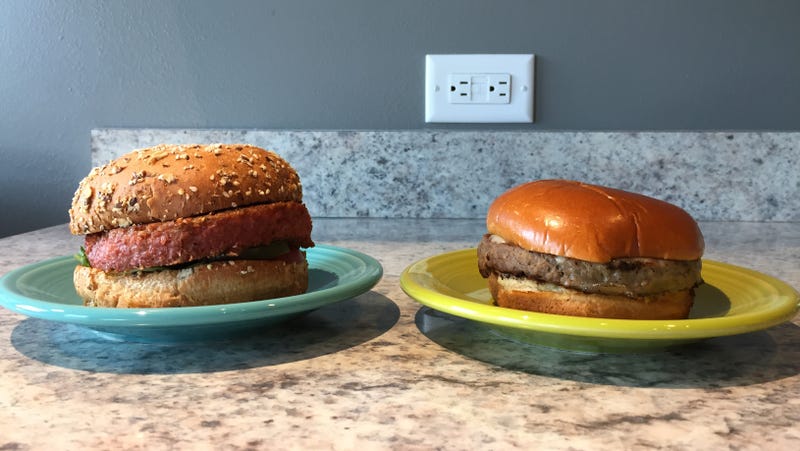
Photo: Nicole Dieker

I have eaten a lot of veggie burgers in my day.

I was a vegetarian for five years before I decided that it would be a lot easier to be the kind of person who eats meat “occasionally”—which, these days, tends to include meat served in someone else’s home or meat ordered at a restaurant when the only vegetarian option is either a pile of carbs or a slice of mushroom. (I also make exceptions for hand-dipped corn dogs, because I grew up in the Midwest, although last year I had a hand-dipped, cornmeal-covered cheese stick that was a highly preferable option.)

Advertisement

The last time I ate a for-real hamburger, just because I wanted to remember what they tasted like, I spent all night stomach-cramping my way to the toilet and back.

So I get why products like the Impossible Burger and the Beyond Burger need to exist. We’re living in a world where we’re eating more meat than can be sustainably produced. A good meat substitute might help us cut back on our animal meat consumption and, by doing so, mitigate some of the damage the meat industry is currently doing to our planet.

We’re also living in a world where many people are vegetarian for ethical or cultural reasons, or—in my case—because they read Michael Pollan’s The Omnivore’s Dilemma and Jonathan Safran Foer’s Eating Animals and stopped eating meat for five years. (I am deliberately avoiding Pollan’s new stuff because I don’t want to be tempted to microdose.)

Advertisement

But, and most importantly, we’re living in a world where hamburgers are delicious. This is why I tried that real burger last year instead of settling for another dry beige patty where you can see, like, a carrot strip clinging to a chunk of pinto bean.

It’s also why I tried both the Impossible Burger and the Beyond Burger. If I could enjoy a non-meat product that tasted as good as meat, I’d never eat another hamburger again.

In order to keep the experiment as standardized as possible, I ordered both my Impossible and Beyond Burgers from local (non-chain) restaurants, photographed them side-by-side, and ate half of each burger at the same meal. (I also got a side of hand-dipped mozzarella sticks, but I don’t think they had any affect on the experiment.)

Advertisement

Here’s how they compared.

Impossible Burger

I ordered my Impossible Burger with no onions, because I’m one of those people for whom the crunch of a raw onion is the oral equivalent of nails on a chalkboard, but I think the person taking my order misunderstood because my burger came with no anything—no lettuce, no tomatoes, no pickle, no mayo/mustard/ketchup. I did get a slice of cheese.

Advertisement

The patty itself was thin and gray and gave off the impression of having been recently dislodged from a plastic wrapper; you weren’t going to mistake this for anything shaped by human hands.

(The bun had also clearly been shaken from a plastic sack, although that wasn’t the burger’s fault.)

Advertisement

Sliced in half, the Impossible Burger interior looked a lot more like a hamburger than I was expecting—a mass-produced burger, to be sure, but you wouldn’t be able to identify this as a non-meat product by its appearance.

Nor by its taste.

Dear readers, this thing tasted like meat.

Or, as Impossible Burger puts it: “meat from cows.”

It didn’t just taste like meat (from cows). It felt like meat in my mouth. Not the kind of hand-pounded hamburger with the grill-blackened exterior and enough heft to leave a lump in your stomach, but the kind of fast-food hamburger that disappears as you chew it, leaving nothing but the satisfaction of having eaten a burger behind.

Advertisement

I would absolutely eat this again. In fact, I already want another one.

Beyond Burger

My Beyond Burger looked like a veggie burger. It was clearly a veggie burger that was trying very hard, plated and served by a restaurant that cared very much about #aesthetics (the oats dotting the bun, the teeny-weeny arugula leaves instead of the slab of iceberg), but... well, this burger was red. Like the Impossible Burger, this puck-shaped patty had been pushed out of a plastic compartment; unlike the Impossible Burger, you could tell at a glance that no cows had been involved.

Advertisement

Sliced in half, the Beyond Burger looked even more unnerving; the inner granules could imply meat, if you were willing to squint, but the color suggested the meat was still raw. According to Beyond Burger, this “red-meat appearance” comes from beets; according to other reviewers, some patties literally bleed. (Mine did not.)

Still, I was expecting to enjoy the Beyond Burger more than I enjoyed the Impossible Burger simply because the overall presentation made it look like the superior product. The patty was thicker. The bun included multiple grains. They left off the onions but didn’t forget to include the other vegetables.

Advertisement

I did enjoy my Beyond Burger.

I’d eat it again.

But it didn’t taste like meat.

At best, the Beyond Burger tastes like a veggie burger wearing a meat costume. This isn’t one of those veggie burgers where you can identify bean halves or mushroom fragments; its texture and mouthfeel are comparable to the kind of real-meat hamburger you might get at the kind of brewpub that cares about using arugula instead of iceberg.

Advertisement

It’s trying really, really hard.

But something’s missing.

On the plus side, the Beyond Burger provided a more complex eating experience than the Impossible Burger did. This isn’t the type of burger that melts in your mouth, giving you enough room to cram in the handful of fries that you’ve just dipped in your milkshake. The Beyond Burger is the kind of burger that demands to be chewed. Savored. Lingered over, maybe, as you and your friends enjoy a beer or three on the patio.

Advertisement

I’m not the only person to note that, of the two leading players in the fake meat market, Impossible has created the slightly better substitute. As Chris Ip reports, in Engadget:

Beyond was first to the grocery stores, first to sell multiple meat products and first to the Nasdaq. But Impossible has arguably the greater soft power based on something simpler: It tastes more like animal meat.

However, I’d recommend you try them both and decide for yourself which one you prefer. After all, Beyond and Impossible share the same goal: to convince consumers to eat less meat overall.

Advertisement

So go ahead and order that fake-meat burger. I bet you’ll like it enough to want to eat another one.

Beyond vs. Impossible: Stats Breakdown

Calories

Beyond: 270

Impossible: 240

Grams of protein:

Beyond: 20

Impossible: 19

Primary protein source

Beyond: Pea

Impossible: Soy

Other ingredients of note:

Beyond: Beet juice extract

Impossible: Heme, which Impossible describes as “an iron-containing molecule that is essential for life.” It’s this soy-derived heme, “identical to the heme from animals,” that gives the burger its real-meat flavor.

Advertisement

Available at:

Beyond: major grocery chains, major restaurant chains including TGIFridays, Carl’s Jr, and Del Taco (full list here)

Impossible: over 5,000 restaurants worldwide (here’s how to find one near you), is scheduled to hit grocery stores later this year

Advertisement

Let's block ads! (Why?)


https://skillet.lifehacker.com/fake-meat-smackdown-impossible-burger-vs-beyond-burge-1835060818

2019-05-28 15:30:00Z
52780305072310

Consumer Confidence Index posts big jump in May, defying trade war gloom - Yahoo Finance


In this Aug. 21, 2015 photo, people shop at the CityTarget store in Boston. Plummeting stock prices have taken a toll on U.S. consumer confidence, though there are signs the setback may be temporary. The University of Michigan says its consumer sentiment index fell to 91.9 Aug. 2014 from 93.1 in July. The index is still up 11.4 percent from a year ago. (AP Photo/Michael Dwyer)

Consumers remain optimistic in the face of a volatile market and a widening trade dispute between the U.S. and China, according to new data from The Conference Board, which rose unexpectedly in May.

The Conference Board’s Consumer Confidence Index, a key metric of consumers’ willingness to keep spending, jumped to 134.1, up from April’s reading of 129.2. A consensus forecast of economists polled by Bloomberg saw the index rising to 130, up from the prior reading of 129.2.

“Consumer Confidence posted another gain in May and is now back to levels seen last Fall when the Index was hovering near 18-year highs,” said Lynn Franco, Senior Director of Economic Indicators at The Conference Board.

While a booming market for jobs helped bolster the outlook, “consumers’ sentiment regarding their income prospects was mixed,” according to Franco.

Earlier this month, a separate sentiment index from Reuters and the University of Michigan showed sentiment surged to a 15-year high, but much of that data was captured before the U.S. and China slapped a new round of tariffs on each other’s imports.

All told, it suggests shoppers are still inclined to keep opening their wallets in the face of mounting pressures on the economy.

The trade war has made for volatile trading on Wall Street and led to concerns that global growth could suffer. A number of businesses and economists also think the $200 billion of tariffs on Chinese goods—and the $60 billion Beijing is poised to slap on U.S. goods in retaliation—will begin trickling down to the consumer.

Walmart (WMT), the world’s largest retailer, said earlier this month that tariffs would result in higher prices for shoppers.

“We are going to continue to do everything we can to keep prices low. However, increased tariffs will lead to increased prices for our customers,” CFO Brett Biggs told reporters on a call.

The Conference Board’s data was also released in the shadow of April retail sales that were far weaker than Wall Street expected. Gas prices, which have fluctuated ahead of the summer driving season, may also be a wild card going forward.

“Consumers expect the economy to continue growing at a solid pace in the short-term, and despite weak retail sales in April, these high levels of confidence suggest no significant pullback in consumer spending in the months ahead,” Franco said.


Javier is an editor for Yahoo Finance. Follow Javier on Twitter: @TeflonGeek

Read more:

Let's block ads! (Why?)


https://finance.yahoo.com/news/the-conference-board-releases-may-consumer-confidence-index-133825261.html

2019-05-28 14:13:00Z
52780304938186

Stocks drift higher, treasury yields dip - Yahoo Finance

Stocks rose Tuesday after a holiday weekend for investors in the U.S. and U.K.

The S&P 500 (^GSPC) increased 0.31%, or 8.76 points, as of 10:16 a.m. ET. The Dow (^DJI) advanced 0.34%, or 86.16 points, while the Nasdaq (^IXIC) rose 0.36%, or 27.22 points.

Treasury prices were bid higher, with yields across the curve falling Tuesday morning. The yield on the 10-year U.S. Treasury note fell 4.2 basis points to 2.287% as of 9:35 a.m., coming off slightly from a 19-month low of just over 2.27%.

Investors returned from Monday’s market closure to face ongoing concerns for the future of U.S.-China trade relations. Over the weekend, President Donald Trump said during a state visit in Japan that the U.S. was “not ready to make a deal” with China, and that tariffs on goods from the country could “go up very, very substantially, very easily.”

However, Trump added that he thinks “sometime in the future China and the United States will absolutely have a great trade deal.”

The Trump administration earlier this month revealed a list of $300 billion worth of Chinese goods that would be affected by a new duty of 25%. China also plans to slap tariffs of up to 25% on $60 billion in U.S. goods starting Saturday.

Despite the trade concerns, U.S. consumers appear for the time being to remain optimistic. The Conference Board’s Consumer Confidence Index, which serves as a gauge consumers’ willingness to spend, surged to 134.1 in May, up from April’s reading of 129.2. This comes following a separate survey from the University of Michigan, which most recently showed sentiment jumped to a 15-year high in May. The survey period for that survey, however, was before the U.S. escalation of tariffs on Chinese-made goods.

Meanwhile, market participants continue to monitor the U.K. contest to replace Theresa May as prime minister, after May last week announced her resignation amid multiple failed attempts to bring Parliament together to deliver a Brexit deal.

Boris Johnson, considered the favorite among Conservative members to take over as prime minister, said Britain would depart from the E.U. at the end of the six-month Brexit extension ending October 31 “deal or no deal.” Foreign Secretary Jeremy Hunt, another candidate in the crowded field of potential successors to May, said pursuing a no-deal exit would amount to “political suicide.”

The British pound (GBPUSD=X) weakened against the U.S. dollar to $1.267 Tuesday morning in New York, while the euro (EURUSD=X) broke below $1.12 amid a spate of election results across the EU.

STOCKS

Fiat Chrysler (FCAU) on Monday announced that it proposed a $35 billion merger with Renault SA (RNO.PA) in a deal that would create the world’s third-largest automaker, behind Toyota and Volkswagen.

The deal would comprise 50-50 ownership between Fiat Chrysler and Renault shareholders after a 2.5 billion euro dividend for existing Fiat Chrysler shareholders, and would be conducted under a listed Dutch holding company. The enlarged business would have the capacity to produce more than 8.7 million vehicles per year, and targeted the equivalent of $5.6 billion in annual savings. Renault said Monday that its board of directors met to examine the proposal.

—

Emily McCormick is a reporter for Yahoo Finance. Follow her on Twitter: @emily_mcck

Read more from Emily:

Follow Yahoo Finance on Twitter, Facebook, Instagram, Flipboard, LinkedIn, and reddit.

Let's block ads! (Why?)


https://finance.yahoo.com/news/stock-market-news-may-28-2019-121356137.html

2019-05-28 13:35:00Z
CBMiS2h0dHBzOi8vZmluYW5jZS55YWhvby5jb20vbmV3cy9zdG9jay1tYXJrZXQtbmV3cy1tYXktMjgtMjAxOS0xMjEzNTYxMzcuaHRtbNIBU2h0dHBzOi8vZmluYW5jZS55YWhvby5jb20vYW1waHRtbC9uZXdzL3N0b2NrLW1hcmtldC1uZXdzLW1heS0yOC0yMDE5LTEyMTM1NjEzNy5odG1s