Sabtu, 29 Februari 2020

Joe Coulombe, founder of popular Trader Joe's markets, dies - The Associated Press

LOS ANGELES (AP) — Joe Coulombe envisioned a new generation of young grocery shoppers emerging in the 1960s, one that wanted healthy, tasty, high-quality food they couldn’t find in most supermarkets and couldn’t afford to buy in the few high-end gourmet outlets.

So he found a new way to bring everything from a then-exotic snack food called granola to the California-produced wines that for flavor compared with anything from France. And he made shopping for them almost as much fun as sailing the high seas when he created Trader Joe’s, a quirky little grocery store filled with nautical themes and staffed not by managers and clerks but by “captains and mates.”

From the time he opened his first store in Pasadena, California, in 1967 until his death Friday at age 89, Coulombe watched his namesake business rise from a cult favorite of educated but underpaid young people — and a few hippies — to a retail giant with more than 500 outlets in over 40 states.

A giant yes, but one that across more than half a century has never lost its reputation for friendly service from employees decked out in goofy Hawaiian shirts, a newsletter that looks like it was published in the 1890s, and rows and rows of high-quality, moderately priced healthy food and great wine, even if you sometimes can’t ever again find exactly the same thing.

“He wanted to make sure whatever was sold in our store was of good value,” said Coulombe’s son, also named Joe, who added that his father died following a long illness. “He always did lots of taste tests. My sisters and I remember him bringing home all kinds of things for us to try. At his offices he had practically daily tastings of new products. Always the aim was to provide good food and good value to people.”

He achieved that by buying directly from wholesalers and cutting out the middleman, in many cases slapping the name Trader Joe’s on a bag of nuts, trail mix, organic dried mango, honey-oat cereal or Angus beef chili. He named several products after his daughters Charlotte and Madeleine and gave quirky names to others. Among them were Trader Darwin vitamins and a non-alcoholic sparkling juice called Eve’s Apple Sparkled by Adam.

He prided himself on checking out every vintage of wine from California’s Napa Valley, including Trader Joe’s standby, Charles Shaw, affectionately known as Two-Buck Chuck because it sold for $1.99. (It still does in the California stores, although shipping costs have increased the price in other states.)

“He sold a lot of better wines too,” his son noted with a laugh, recalling trips the family made to France to seek them out.

After selling Trader Joe’s to German grocery retailer Aldi in 1979, Coulombe remained as its CEO until 1988, when he left to launch a second career as what he called a “temp,” coming in as interim CEO or consultant for several large companies in transition. He retired in 2013.

Joseph Hardin Coulombe, an only child, was born on June 3, 1930, in San Diego and lived on an avocado ranch in nearby Del Mar. After serving in the Air Force, he attended Stanford University, where he earned a bachelor’s degree in economics, a master’s in business administration and met and married his wife, Alice.

A few years after graduation, he was hired by the Rexall drugstore chain, which tasked him with establishing a chain of convenience stores called Pronto. When Rexall lost interest in the stores, he bought them and had grown the chain to about a dozen outlets when the huge 7-Eleven company made a major push into Southern California.

“So I had to do something different,” he told the Los Angeles Times in 2014. “Scientific American had a story that of all people qualified to go to college, 60% were going. I felt this newly educated — not smarter but better-educated — class of people would want something different, and that was the genesis of Trader Joe’s.”

His wife’s parents had introduced him to a world of foods previously unfamiliar to him, including fine olive oil, fresh seafood and inexpensive quality wine, and he figured things like that would be perfect for the younger audience he was seeking.

As he bargained for those products, he’d sometimes come across a particularly exceptional olive oil or vintage wine, never to find it again, and he wouldn’t stock an inferior product in its place.

He eschewed promotional gimmicks like loyalty clubs or loss-leader sales, getting the word out with brief radio spots and the Trader Joe’s “Fearless Flyer” newsletter, whose old-style appearance was inspired by another money-saving effort. He wanted to dress up the newsletter’s stories with illustrations he cut out of magazines, but he made sure he only took ones on which the copyrights had expired.

He passed such savings on not only to his customers but employees, which Trader Joe’s boasts are among retail’s best compensated, with medical, dental, vision and retirement plans and annual salary increases the company says range from 7% to 10%. Many workers have remained with Trader Joe’s for decades.

“He just had a visit yesterday from employee No. 1,” his daughter Charlotte said shortly before her father’s death.

He and his wife also became well known in Southern California philanthropic circles, contributing time and money to such causes as Planned Parenthood, the Los Angeles Opera and the Huntington Library, Art Museum and Botanical Gardens.

Stories differ on how the name Trader Joe’s came about, with some saying it was inspired by a ride on Disneyland’s Jungle Cruise boat or a book he read called “White Shadows in the South Seas” or his favorite college hangout being a Trader Vic’s bar near Stanford.

Coulombe, who loved to travel, did acknowledge over the years that he had a fascination with the South Seas and put Trader into the name and a nautical theme inside the stores to lend that exotic appeal to customers.

In addition to his three children and wife of 67 years, Coulombe is survived by six grandchildren.

Let's block ads! (Why?)


https://news.google.com/__i/rss/rd/articles/CBMiM2h0dHBzOi8vYXBuZXdzLmNvbS83ZTU4Y2Y3NmU3M2FiYTcwNzM2MDgxYTA2ZTI3MTVmYdIBAA?oc=5

2020-02-29 07:34:28Z
52780639202251

China Manufacturing Plunges in February Amid Virus Controls - The New York Times

BEIJING — China’s manufacturing plunged in February by an even wider margin than expected after efforts to contain a virus outbreak shut down much of the world’s second-largest economy, an official surveyed showed Saturday.

The survey, coming as global stock markets fall on fears the virus will spread abroad, adds to mounting evidence of the vast cost of the disease that emerged in central China in December and its economic impact worldwide.

The monthly purchasing managers’ index issued by the Chinese statistics agency and an industry group fell to 35.7 from January’s 50 on a 100-point scale on which numbers below 50 indicate activity contracting.

A sub-measure of imports plummeted, highlighting the shock waves spreading through China’s Asian neighbors and other suppliers of components and raw materials to its factories, which assemble most of the world's smartphones, toys, home appliances and other consumer goods.

"Supply chains are likely to remain disrupted even if China's factories go back to full production,” due to spreading travel bans and other anti-virus controls abroad, said Iris Pang of ING in a report. She said it was “incredibly unlikely” the global flow of goods would recover even in April.

The PMI decline was widely anticipated after the government extended the Lunar New Year holiday to keep factories and offices closed but the figure was even more severe than many forecasters expected. Many analysts expected a result in the low 40s, which already would have been the lowest since the PMI first was issued in 2002.

Stock markets in the United States, Europe and Japan tumbled by about 10% over the past week after outbreaks in South Korea, Iran and Italy. Oil prices have sunk on expectations manufacturing worldwide might decline.

The official PMI is compiled by the National Bureau of Statistics and the China Federation of Logistics & Purchasing.

Other major economic indicators “are expected to decline significantly” in the three months ending in March, said a government economist, Zhang Liqun, in a statement they released.

The Communist Party is trying to revive business activity in some parts of China while ordering areas deemed at high disease risk to stay focused on fighting the virus.

The government has cut a key interest rate and promised companies tax breaks, low-cost loans and other aid. Local officials have orders to help millions of employees get back to work while preventing a rebound in infections.

Most access to Wuhan, a manufacturing hub with 11 million people where the disease first emerged, was suspended Jan. 23. Controls on travel spread to cities with a total population of 60 million and restaurants, shops, cinemas and other businesses nationwide were ordered to close. Sales of autos and real estate fell close to zero.

Some industries, including state-owned steel and copper mills, operated at normal levels throughout the shutdown, helping to buoy the official activity reading.

The PMI highlighted the bigger blow suffered by the small, mostly private companies that are the country’s economic engine, produce goods for global brands and supply components for smartphones and other consumer electrics.

A measure of production fell to 26.1 among small enterprises, while the measure for bigger companies was 28.3.

The measure for imports fell to 31.9 from January’s 57.

The official PMI draws on a sample of companies that is weighted toward larger, state-owned companies that serve the Chinese market. A separate PMI with more private companies and exporters is due to be released Monday by a Chinese business magazine.

The previous lowest PMI readings were in the mid-40s following the 2008 global financial crisis.

Manufacturing activity normally would be expected to rebound in February as factories reopen and replenish raw materials following the Lunar New Year, when many shut down for two weeks or more.

Regulators say Chinese industry is reviving but activity still is weak.

The 18 million small, mostly private companies that account for the bulk of industrial activity and employment are back to operating at one-third of normal levels, officials said Thursday at a news conference. An official of the Cabinet planning agency, Zhang Kejian, said activity is increasing by about 1% per day.

It is unclear how many factories and other employers might be forced to close for good under the burden of paying rent and other expenses with no revenue.

Global automakers are reopening factories but say the pace will depend on how quickly the flow of components from suppliers resumes. Forecasters say auto industry activity won’t return to normal until at least mid-March.

Let's block ads! (Why?)


https://news.google.com/__i/rss/rd/articles/CBMiZWh0dHBzOi8vd3d3Lm55dGltZXMuY29tL2Fwb25saW5lLzIwMjAvMDIvMjgvYnVzaW5lc3MvYmMtdmlydXMtb3V0YnJlYWstY2hpbmEtbWFudWZhY3R1cmluZy1zbHVtcC5odG1s0gEA?oc=5

2020-02-29 04:35:00Z
52780636923491

Jumat, 28 Februari 2020

Stock Market Continues to Plummet in Worst Week Since 2008: Live Updates - The New York Times

Panic in the stock market over the spreading coronavirus continued into a seventh day on Friday, with shares in the United States tumbling following steep declines in Asia and Europe.

The S&P 500 index dropped more than 3 percent in early trading Friday. Before trading began, the index was already down more than 12 percent from a record high reached just last week, and the drop has put the index on track for its worst week since the 2008 financial crisis.

The sell-off is fueled mostly by worry that measures to contain the virus would hamper corporate profits and economic growth, and fears that the outbreak could get worse. The selling has dragged stock benchmarks around the world into a correction — a drop of 10 percent or more that’s taken as a measure of extreme pessimism — in a matter of days.

A potential outbreak in the United States represents a significant test for President Trump, whose presidential success has been deeply tied to the economy and a rising stock market.

On Friday, the slide in Asia and Europe followed a 4.4 percent nose-dive in the S&P 500 index on Thursday, the worst day for American shares since 2011.

  • In Europe, the FTSE 100 in Britain and the DAX in Germany fell more than 4 percent.

  • In Asia, the Nikkei 225 in Japan closed down 3.7 percent, the KOSPI in South Korea dropped 3.3 percent and the Shanghai Composite in China dropped 3.7 percent.

  • Oil prices continued a lurching drop, reflecting decreased demand as factories and transportation slow down. Brent crude, the international benchmark, fell as low as $50.05 a barrel. It was above $71 in early January.

  • Investors have also poured into investments like gold and government bonds, which are generally considered safer.

Federal Reserve officials on Friday began to signal a willingness to cut interest rates if the outbreak worsens, laying out a scenario in which the central bank might respond as infections and quarantines spread globally.

“Further policy rate cuts are a possibility if a global pandemic actually develops with health effects approaching the scale of ordinary influenza, but this is not the baseline case at this time,” said James Bullard, president of the Federal Reserve Bank of St. Louis, in prepared remarks on Friday. Mr. Bullard does not vote on monetary policy this year but participates in policy discussions.

The Coronavirus Outbreak

  • Answers to your most common questions:

    Updated Feb. 26, 2020

    • What is a coronavirus?
      It is a novel virus named for the crownlike spikes that protrude from its surface. The coronavirus can infect both animals and people and can cause a range of respiratory illnesses from the common cold to more dangerous conditions like Severe Acute Respiratory Syndrome, or SARS.
    • How do I keep myself and others safe?
      Washing your hands frequently is the most important thing you can do, along with staying at home when you’re sick.
    • What if I’m traveling?
      The C.D.C. haswarned older and at-risk travelers to avoid Japan, Italy and Iran. The agency also has advised against all nonessential travel to South Korea and China.
    • Where has the virus spread?
      The virus, which originated in Wuhan, China, has sickened more than 80,000 people in at least 33 countries, including Italy, Iran and South Korea.
    • How contagious is the virus?
      According to preliminary research, it seems moderately infectious, similar to SARS, and is probably transmitted through sneezes, coughs and contaminated surfaces. Scientists have estimated that each infected person could spread it to somewhere between 1.5 and 3.5 people without effective containment measures.
    • Who is working to contain the virus?
      World Health Organization officials have been working with officials in China, where growth has slowed. But this week, as confirmed cases spiked on two continents, experts warned that the world was not ready for a major outbreak.

While his statement is far from a signal that the Fed will cut interest rates at its mid-March meeting, it does lay out what the path toward a response would look like. As coronavirus cases mount in countries outside of China and fuel worries that the world is staring down a pandemic mount, market probabilities have skyrocketed that the central bank will slash borrowing costs next month to cushion the economy.

But rate cuts may have a limited effect: They work by stimulating demand, which could help if consumers and investors get spooked and stop spending. But cuts will do little to restart factories and correct supply problems.

China, the site of the first cases and the world’s second largest economy, has ground to a halt as it struggles to contain the infection. Its factory shutdowns and quarantines have disrupted the global supply chain. Companies like Microsoft have warned that this will affect their sales, and Wall Street analysts have begun to factor those warnings into their expectations for profit growth this year.

More countries are reporting outbreaks, with over 83,000 people worldwide in at least 53 countries sickened so far. Hundreds of companies have begun taking measures to try to prevent the illness from afflicting their workers, including restricting travel and asking employees to work from home. All of these could curtail productivity.

“The economic implications of the coronavirus are difficult to ascertain as government and personal reactions to the epidemic are unprecedented,” analysts at Keefe, Bruyette & Woods wrote in a research note to their clients. “We expect that economic conditions will rebound once quarantines are lifted, but there will be a certain amount of activity that will be lost."

Investors are responding by selling stocks, as well as commodities like oil, as they anticipate the coming slump. The selling itself could help bring the slowdown along as it discourages spending by companies and individual investors alike.

Investment bank economists issued increasingly glum predictions of how much the coronavirus outbreak would hurt economies around the world.

Scott Clemons, the chief investment strategist for private banking at Brown Brothers Harriman, said the outbreak’s potential to alter American consumers’ habits was at the heart of the Wall Street sell-off.

“To the degree that consumers change their behavior — so they stop going out to eat, they don’t take the vacation, they cancel the business trip — that consumption, that spending, personal consumption is 68 percent of G.D.P.,” Mr. Clemons said.

Over the past few days, companies as varied as United Airlines, Anheuser-BuschInBev, Mastercard and Pfizer have said that the outbreak poses a threat to their 2020 earnings, and the overall effect of the outbreak on global corporations could increase the chance of a broader economic slowdown, analysts say.

“The more countries that are faced with fighting a pandemic, the wider the potential for economic disruption and potential for increased recessionary risks,” Tai Hui, the chief market strategist for Asia at J.P. Morgan Asset Management, said in a research note on Friday.

  • Baker McKenzie, the law firm based in Chicago, shut its London office, which houses about 1,000 people, after a potential coronavirus case.

  • The airline group IAG, which owns British Airways and Iberia, said that it expected earnings to be weaker because of the virus, but it could not give accurate profit guidance for the year because of the uncertainty of the situation.

  • The Swiss government banned all gatherings of more than 1,000 people at least until March 15, forcing cancellation of the Geneva International Motor Show.

Amie Tsang, Matt Phillips, Jack Ewing, Keith Bradsher, Alexandra Stevenson and Julie Creswell contributed reporting.

Let's block ads! (Why?)


https://news.google.com/__i/rss/rd/articles/CBMiT2h0dHBzOi8vd3d3Lm55dGltZXMuY29tLzIwMjAvMDIvMjgvYnVzaW5lc3Mvc3RvY2stbWFya2V0LXRvZGF5LWNvcm9uYXZpcnVzLmh0bWzSAVNodHRwczovL3d3dy5ueXRpbWVzLmNvbS8yMDIwLzAyLzI4L2J1c2luZXNzL3N0b2NrLW1hcmtldC10b2RheS1jb3JvbmF2aXJ1cy5hbXAuaHRtbA?oc=5

2020-02-28 15:35:00Z
CAIiEJpoE1N41yx9RdbO7xNwUAQqFwgEKg8IACoHCAowjuuKAzCWrzwwt4QY

Dow drops 800 at open, extending worst week since financial crisis - MSNBC

The stock market cratered again on Friday, marking the seventh day of a massive sell-off sparked by rising fears about the coronavirus epidemic. The Dow Jones Industrial Average plunged by 800 points at the opening bell, with the S&P 500 and the Nasdaq each falling by 3 percent.

Let's block ads! (Why?)


https://news.google.com/__i/rss/rd/articles/CBMieWh0dHBzOi8vd3d3Lm1zbmJjLmNvbS9zdGVwaGFuaWUtcnVobGUvd2F0Y2gvZG93LWRyb3BzLTgwMC1hdC1vcGVuLWV4dGVuZGluZy13b3JzdC13ZWVrLXNpbmNlLWZpbmFuY2lhbC1jcmlzaXMtNzk2MDk5MjU4NDHSATVodHRwczovL3d3dy5tc25iYy5jb20vbXNuYmMvYW1wLXZpZGVvL21tdm83OTYwOTkyNTg0MQ?oc=5

2020-02-28 14:59:03Z
52780630255565

5 things to know before the stock market opens Friday - CNBC

1. Dow set to sink again after biggest point-loss ever

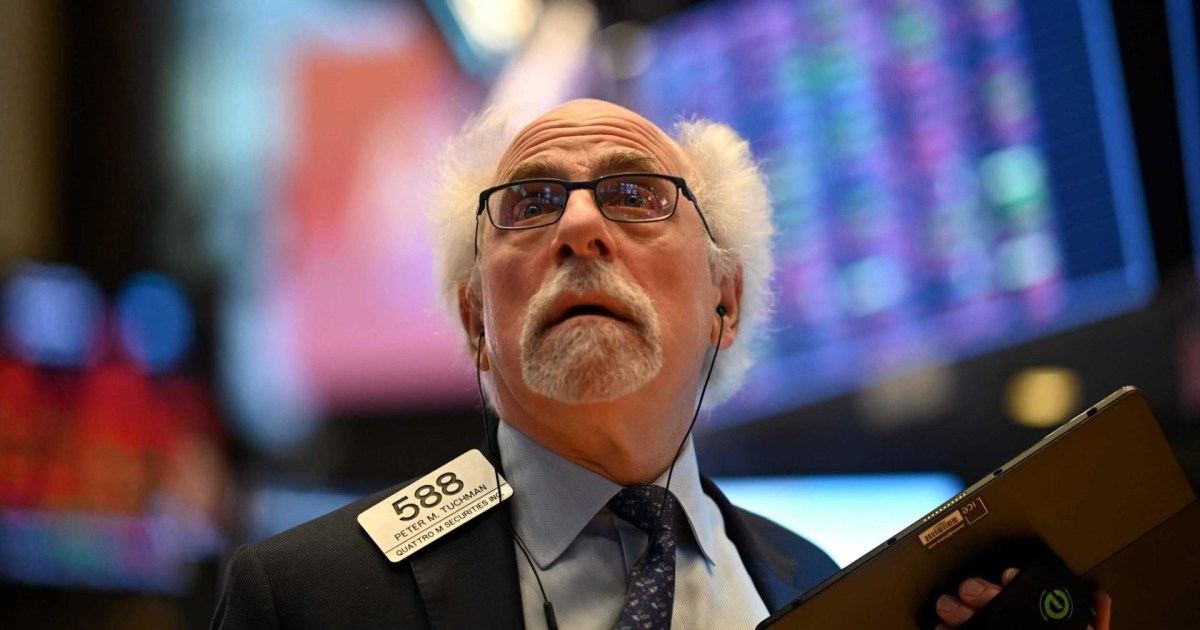
Traders work during the opening bell at the New York Stock Exchange (NYSE) on February 27, 2020 at Wall Street in New York City.

Johannes Eisele | AFP | Getty Images

U.S. stock futures were pointing to a 500-point decline for the Dow Jones Industrial Average at Friday's open on Wall Street, pushing blue chips further into a correction. Fears of a possible coronavirus pandemic crushed stocks this week, with the Dow off more than 11% and tracking for its worst weekly performance since the 2008 financial crisis. The Dow finished at a record high just 11 sessions ago on Feb. 12. As of Thursday's close, it was down nearly 13% since then. Thursday's nearly 4.4% decline for the Dow was the worst day back to February 2018. The Dow's nearly 1,200 point plunge Thursday was its worst point-loss ever.

2. 10-year Treasury yield collapses to another record low

Investors are dumping global stocks as well, with markets from Europe to Asia down 3% to 5%, and they're pouring money into the perceived safety of bonds. The 10-year U.S. Treasury yield, which moves inversely to price, hit another record low below 1.2%. The 10-year yield serves as a benchmark for mortgage rates, auto loans, student loans, credit card annual percentage rates and other debt instruments. The yields on the 2-year and 5-year Treasurys were trading below 1% early Friday. Global markets have lost $6 trillion in value over the past six days, according to S&P Dow Jones Indices.

3. Market expectations of Fed rate cut increasing

The carnage in stocks and plummeting Treasury yields are raising market expectations of a Federal Reserve interest rate cut. Ex-Fed Gov. Kevin Warsh told CNBC on Friday he sees a coordinated global central bank action soon in response to coronavirus. Before the outbreak, the Fed was telling the market it planned to hold rates steady for a while after three cuts of 0.25% each last year. A Fed official during the financial crisis in 2008, Warsh has been critical of Fed officials for not normalizing interest rates sooner and thus leaving themselves more room to act in times of crisis.

4. WHO warns coronavirus could reach every country

The World Health Organization on Friday reiterated its warning that COVID-19 could reach every country on Earth. On Tuesday, the WHO had warned countries around the world to be prepared for the coronavirus to be "literally knocking at the door." Infections continued to rise in hot spots outside of China — in South Korea, Iran, the U.K., Germany and Italy. The U.S. has about 60 cases. The vast majority of infections and deaths are still in China, where officials increased the count of confirmed cases to nearly 79,000, with fatalities approaching 2,800.

5. Biden looks to South Carolina and then Super Tuesday for comeback

Joe Biden leaving a campaign event in Georgetown, South Carolina on Feb. 26, 2020.

Tucker Higgins / CNBC

Heading into Saturday's South Carolina primary, former Vice President Joe Biden was leading in the polls after poor results in Iowa, New Hampshire and Nevada. A political action committee backing the embattled former front-runner for the Democratic presidential nomination invested in key Super Tuesday states. Biden is third so far in the delegate count, behind Sen. Bernie Sanders and Pete Buttigieg. Mike Bloomberg, a latecomer to the race, will be on ballots for the first time on Super Tuesday, when a third of the party's delegates are up for grabs.

Let's block ads! (Why?)


https://news.google.com/__i/rss/rd/articles/CBMiZGh0dHBzOi8vd3d3LmNuYmMuY29tLzIwMjAvMDIvMjgvNS10aGluZ3MtdG8ta25vdy1iZWZvcmUtdGhlLXN0b2NrLW1hcmtldC1vcGVucy1mZWJydWFyeS0yOC0yMDIwLmh0bWzSAWhodHRwczovL3d3dy5jbmJjLmNvbS9hbXAvMjAyMC8wMi8yOC81LXRoaW5ncy10by1rbm93LWJlZm9yZS10aGUtc3RvY2stbWFya2V0LW9wZW5zLWZlYnJ1YXJ5LTI4LTIwMjAuaHRtbA?oc=5

2020-02-28 12:33:00Z
52780630255565

Dow Futures Extend Slump Amid Worst Stock Market Slide Since Global Financial Crisis - TheStreet

Dow Futures Extend Slump Amid Worst Stock Market  Slide Since Global Financial Crisis

Wall Street looks set to extend its worst week since the financial crisis -- and the fastest correction on record for the S&P 500 -- as investors fear the coronavirus will accelerate into a global pandemic.
Author:
Updated:
Original:

The Friday Market Minute

  • Global stocks near correction territory, amid the worst five-day stretch since November 2008, as health officials warn of a potential cornoavirus pandemic.
  • COVID-19 cases top 83,000 worldwide, with new infections in Africa and New Zealand overnight, as governments accelerate their response procedures and biotechs race to find an effective vaccine.
  • European stocks extend slump, taking the Stoxx 600's five-day decline to 11.6%, with basic resource and tech shares leading the decline.
  • Benchmark 10-year U.S. Treasury bond yields hit fresh all-time low of 1.15% in overnight trading, with 2-year notes slipping below 1%, as investors bet on central bank support and Fed rate cuts amid the fastest correction on record for the S&P 500.
  • The CBOE's VIX volatility index hits a two-year high of 45.67, sending stocks reeling as investors dump risk in markets around the world.
  • U.S. equity futures suggest further opening bell declines on Wall Street ahead of earnings from Foot Locker before the start of trading and January inflation data at 8:30 am Eastern time.

Wall Street's historic rout looks set to continue Friday, with futures prices pointing to extended declines for the three major benchmarks amid the worst week for world stocks since the financial crisis, as investors prepare for what could be a global coronavirus pandemic. 

Asia stocks were pummeled in overnight trading, following on from last night's sell-off on Wall Street that hived more than 1,000 points from the Dow Jones Industrial Average for the second time this week, pulling the MSCI World stock benchmark closer to correction territory, wiping out more than $5 trillion in equity value and setting up its worst five-day run since November 2008.

With Moody's Investors Service warning of the potential for a coronavirus-lead global recession, supply chains disrupted by China's ongoing health crisis and the lingering effects of its trade war with the United States and government bond yields around the world testing fresh all-time lows, risk appetite was in short supply Friday, with gold price rising, oil extending declines and fund manager cash piles expanding.

More than 83,000 people -- mostly in China but in rising numbers around the world -- have been infected by the respiratory virus, officially known as COVID 19, with new cases confirmed overnight in Nigeria, New Zealand and Lithuania.

"This virus has pandemic potential," World Health Organization Director General Tedros Adhanom Ghebreyesu said Thursday. "This is not a time for fear. This is a time for taking action to prevent infection and save lives now."

With an unknown lethality and a rising infection rate, COVID 19's impact on the global economy is unknown at this stage, but with U.S. equity valuations recently trading at their highest levels since 2002, investors are in little mood to speculate on the ultimate outcome of any pandemic.

U.S. equity futures, in fact, suggest another session of deep declines on Wall Street Friday, with contracts tied to the Dow Jones Industrial Average priced for a 540 point slide, taking the five-day total to around 1,600 points, and those linked to the S&P 500 poised for a 60 point retreat.

The S&P 500, in fact, suffered its fastest "correction" -- where stocks fall from 10% from a recent peak -- on record as of yesterday when the benchmark closed under the 3,000 point mark after hitting an all-time high on February 19. Nasdaq futures suggest a 144 point opening bell decline.

Benchmark 10-year U.S. Treasury bond yields, meanwhile, fell to a fresh all-time low of 1.15% mark in early European trading, extending a decline that has clipped more than 70 basis points from one of the world's most liquid financial instruments since the beginning of the year. Two-year notes, meanwhile, traded below the 1% mark for the first time on record, a move that was shortly followed by a similar level for 5-year notes.

With bond yields tumbling, pressure continues to mount on the Federal Reserve -- and indeed other central banks around the world -- to respond with either rate cuts or targeted monetary support.

Chicago Fed President Charles Evans, however, told a financial conference in Mexico Thursday that it would be "premature" to talk about central bank action in the wake of COVID 19's spread, and repeated the Fed's stance of "closely monitoring" developments in the global economy.

CME Group futures, however, now suggest at least a 77% chance of a March rate cut, compared to just 9% only a week ago, and are fully pricing in further cuts between now and the end of the year.

European stocks opened notably weaker in Frankfurt, London and Milan, with the Stoxx 600 benchmark tumbling 3% by mid-day of trading, while the FTSE 100 slumped 3% to the lowest levels since 2016 in London.

Germany's DAX index, which has fallen 15% from its recent highs, was marked 3.8% lower by mid-morning trade in Frankfurt.

In Italy, where the number of coronavirus cases has risen to 655 -- from just 3 a week ago -- with at least 17 deaths, the benchmark FTSE MIB index fell 3.4% in early dealing in Milan.

Global oil prices, too, extended declines amid their worst five-day stretch in four years, taking Brent crude some 15% lower on the week as investors adjusted demand forecasts from both China and other major economies around the world.

Brent crude futures contracts for April delivery, the global benchmark, were last see seen $2.1 lower from their Thursday close in New York and trading at $50.08 per barrel, while WTI contracts for the same month were seen $2.07 lower at $45.02 per barrel.

Overnight in Asia, Japan's Nikkei closed out a 9.6% slide for the week with a 3.67% slump that pegged the benchmark at 21,142.96 points, while China's Shanghai Composite fell 3.7% and Hong Kong's Heng Seng index tumbled 2.71%.

Let's block ads! (Why?)


https://news.google.com/__i/rss/rd/articles/CBMiXmh0dHBzOi8vd3d3LnRoZXN0cmVldC5jb20vaW52ZXN0aW5nL2Rvdy1mdXR1cmVzLWZhbGwtd29yc3Qtc2xpZGUtc2luY2UtZ2xvYmFsLWZpbmFuY2lhbC1jcmlzaXPSAWNodHRwczovL3d3dy50aGVzdHJlZXQuY29tLy5hbXAvaW52ZXN0aW5nL2Rvdy1mdXR1cmVzLWZhbGwtd29yc3Qtc2xpZGUtc2luY2UtZ2xvYmFsLWZpbmFuY2lhbC1jcmlzaXM?oc=5

2020-02-28 12:13:00Z
52780637805329

The Week That Wiped $3.4 Trillion Off the Stock Market - The Wall Street Journal

When the S&P 500 closed at a record on Feb. 19, American stocks seemed untouched by the anxiety around the coronavirus epidemic that had already rattled investors in other markets, including bonds, commodities and some foreign shares.

Nine days later, an unnerving reality has set in. The S&P 500 has just suffered its fastest-ever 10% decline from an all-time high. The Dow Jones Industrial Average is headed for its worst week since the start of the 2008 global financial crisis. Shares of manufacturers, banks and utilities alike have dropped by double digits.

Andrew Freedman, a 31-year-old finance professional, was in an Uber in Connecticut on Monday morning when he noticed his driver fiddling with his phone. When he asked his driver to pay attention to the road, he was stunned by his response: “Do you mind if I pull over for a minute? The market’s open, I have to sell some things.”

Weary traders describe the past week as one of the most trying stretches on Wall Street in recent memory. Investors and analysts pore over the latest news on quarantines, illness counts and death rates, only to have those figures overtaken by events and overshadowed by reports that often can’t be substantiated. Portfolio managers are deluged with calls from clients asking questions no one can answer.

SHARE YOUR THOUGHTS

Why do you think U.S. stock investors were so sanguine about the coronavirus until recent days? Join the conversation below.

Financial markets are in unsettling new territory. For decades, discussion of the market had often centered around whether stocks were in a bubble—in other words, if their gains had outstripped economic reality. There was the dot-com bubble. The housing bubble. And more recently, debate over whether a record-long run in stocks had made the market ripe for a fall. But the coronavirus represents something new: a non-financial, exogenous force whose impact on the global economy is huge and unknowable. The smartest minds on Wall Street and beyond are having difficulty discerning whether the epidemic will end up being a short-term disruption, or a more sustained and lasting threat that upends the lives of millions of people around the world.

Will the offices and factories and schools of America and Europe close up like the ones in China did? Will the streets empty out and shops shutter their doors as people retreat to their homes? How long will it take for scientists to understand the workings of the virus and develop medicines that can slow it down? Until the answers to some of those questions become clearer, traders say, the market could have trouble finding a bottom.

“Everybody’s just trying to figure out where are the next rumors coming from and where the viruses are hitting and how bad they are,” said Thomas di Galoma, managing director of rates trading at Seaport Global Securities in New York.

Over the course of six days of selling, the S&P 500 dropped 12% from its peak—wiping out $3.4 trillion in market value.

Going Down
The S&P 500's cumulative decline from its Feb. 19 peak compared to six other corrections that occurred in the current bull market
April-July 2010
April-Oct. 2011
May-Aug. 2015
Nov. 2015-Feb. 2016
Jan.-Feb. 2018
Sept.-Dec. 2018
Feb. 2020
TRADING DAYS
Note: Current decline is as of Thursday's close.
Source: Dow Jones Market Data

The yield on the 10-year U.S. Treasury note—a bedrock of global finance—has tumbled to a record low, indicating soaring prices as traders from other markets seek out the safety of debt issued by the richest nation in the world.

In the Treasurys market, those who have been trying to fight off the precipitous slide in bond yields “have gotten stomped out,” said Mr. di Galoma.

The rout marks the staunchest test yet for a U.S. stock bull market that started 11 years ago next month. Investors have learned over the past decade that it pays to stay invested in stocks, a mindset that has paid off handsomely for those who have used recession scares in 2011, 2015-2016 and 2018 to add to shareholdings at lower prices.

At the same time, this rally has been by acclamation the most hated ever, one in which traditional stock mutual funds suffered significant outflows and some of the most visible buyers of shares were corporations pursuing buybacks to reduce their share counts and put extra cash to work. Households who saw their portfolios eviscerated by the financial crisis have been reluctant to return to the market. Even seasoned money managers have at times expressed disdain for the rally. They’ve argued that the stock market was juiced by the extraordinary monetary policy central banks put in place after the financial crisis. To them, stocks looked ripe for a selloff long before the coronavirus epidemic surfaced. They just weren’t sure what the trigger would be.

The question for now in markets is whether the steep decline of the past week will be just another blip on the way to further highs in this cycle, whether the crash that a handful of bears have been calling for for years is actually at hand, or whether this is something even worse that no one foresaw at all.

Tony Roth, chief investment officer at Wilmington Trust Investment Advisors, said the firm’s investment committee had several emergency meetings before deciding to lower its position in stocks to less than the benchmark it tracks early in the week.

As new pockets of infection have emerged outside China, Italy, South Korea and Iran are scrambling to contain the spread of the coronavirus. Photo: Zuma Press

Before that change, Wilmington Trust held a larger investment in stocks than its benchmark, and the move from an “overweight” position to “underweight” marked the first such change in the 5½ years Mr. Roth has been at the firm.

“This is something that’s unprecedented in modern times, and the markets are now reacting in a way that’s more realistic,” Mr. Roth said. “We view this as a pretty significant shock to the system.”

The market’s rout began in earnest Monday, after news over the weekend of the virus spreading rapidly in Italy showed investors that the pandemic had evolved from a Chinese crisis into a global and increasingly out-of-control problem. That realization sent the Dow tumbling more than 1,000 points and the yield on the 10-year U.S. Treasury note fell briefly below an intraday record.

But for many, the market’s turning point came Tuesday, when officials from the U.S. Centers for Disease Control and Prevention issued a stark warning. Experts now expected the coronavirus to spread widely throughout the country. Schools and businesses should brace themselves against a potential outbreak, officials said.

The CDC’s warning drove home a point that many had largely dismissed just weeks prior—that the U.S. might not escape the disruption caused by the coronavirus that has already brought to a halt everyday life in China, Italy, South Korea and other countries.

Wall Street was quick to respond. By Thursday, analysts at Goldman Sachs Group Inc. warned they no longer expected U.S. companies to post any earnings growth at all in 2020. With the epidemic threatening to evolve into a pandemic, it’s likely that U.S. exporters will see a drop in demand for their products and that companies will suffer disruptions in their supply chains, said David Kostin, Goldman’s chief U.S. equity strategist.

Investors fled riskier assets across the board, sending the S&P 500 to correction territory, or a drop of at least 10% from its most recent high. The speed with which the correction occurred caught many by surprise; the index’s descent, taking just six trading days, marked its fastest turn into correction territory ever.

Just after stocks had finished at an all-time high Feb. 19, Stevie Onuska, a 26-year-old DJ in Nashville, Tenn., was on the mobile trading app Robinhood trying to make a profit off of bets on chipmaker Advanced Micro Devices Inc. “I was thinking, cool, everything’s going to stay up. It’s had a great record,” he said.

Then the market selloff began. “That was when I was like, ‘oh crap, I’m out,’” he said.

Shares of airlines, hotels and cruise operators—whose profits are likely to drop as quarantines and health warnings stop consumers from traveling—were among the worst hit in the past week of selling. Banks also slumped, with Bank of America Corp. and JPMorgan Chase & Co. bringing their losses for the year to more than 10% apiece.

Meanwhile, traders searching for opportunities found havens in unusual places. Bleach producer Clorox Inc. shares gained 0.4% Thursday even as the Dow racked up its second 1,000-point loss in four days. 3M Co., which has ramped up production of protective masks, was up 0.8%.

As traders rushed to place bets or hedge against further losses, exchanges were hit by a spike in trading volumes.

The moves weren’t limited to so-called active investors, who pick and choose the companies they want to invest in. Passive investors who typically buy and hold index-tracking funds for prolonged periods of time also fled the market—potentially exacerbating the selling pressure hitting the stock market.

Trading volumes on the SPDR S&P 500 ETF Trust, an index-tracking fund that’s one of the most-traded securities in the world, jumped 300% above average, according to Jonathan Krinsky, chief market technician at Bay Crest Partners.

It’s exactly the sort of reaction you’d expect for a moment when investors start doubting the strength of the economy. The S&P 500 fell 12% the week after U.S. officials reopened markets for trading following the Sept. 11 attacks in 2001. And stocks fell as much as 13% during the course of the 2003 outbreak of severe acute respiratory syndrome, or SARS, according to Citigroup Inc. In both cases, markets ultimately recovered their losses—but only as it became more apparent that the global economy would recover. Until investors have more clarity on a number of issues—including the true scope of the infection, and whether scientists will be able to deliver effective vaccines and treatments—they say it’s likely that markets will continue to face significant pressure.

Not all investors are in panic mode. In fact, most of the calls that Jason Pride, chief investment officer for private clients at Glenmede Trust, has received in the past few days have been from clients asking when they should step in and buy the dip.

Mr. Pride isn’t alarmed yet. He is hopeful that health officials’ efforts to contain the epidemic will prove fruitful, and that ultimately, the slowdown in economic activity around the world will prove to be temporary—not the start of a deep downturn.

But even he isn’t giving his clients the all clear. The speed with which markets have shrunk from their highs has Mr. Pride skeptical the selloff is at its end.

“We’re not there yet,” Mr. Pride said.

Write to Akane Otani at akane.otani@wsj.com

Copyright ©2019 Dow Jones & Company, Inc. All Rights Reserved. 87990cbe856818d5eddac44c7b1cdeb8

Let's block ads! (Why?)


https://news.google.com/__i/rss/rd/articles/CBMiXmh0dHBzOi8vd3d3Lndzai5jb20vYXJ0aWNsZXMvdGhlLXdlZWstdGhhdC13aXBlZC0zLTQtdHJpbGxpb24tb2ZmLXRoZS1zdG9jay1tYXJrZXQtMTE1ODI4OTEyMjPSAQA?oc=5

2020-02-28 12:00:00Z
52780637620792